Magnetic Poles
There are different ways of defining magnetic poles, which are different from the geographic poles.
The geographic poles are the points where the axis the Earth rotates around meets the surface, and are antipodal (symmetrically opposite) at +/-90° latitude.
The most common understanding of magnetic poles is that they are the positions on the Earth's surface where the geomagnetic field is vertical. These poles are called dip poles, and the north and south dip poles do not have to be (and are not now) antipodal. In principle the dip poles can be found by experiment, conducting a magnetic survey to determine where the field is vertical.
Another definition comes from global models of the geomagnetic field. Models of this type, such as the International Geomagnetic Reference Field (IGRF) include an equivalent (but fictional) magnetic dipole at the centre of the Earth in their representation of the field. This dipole defines an axis that intersects the Earth's surface at two antipodal points. These points are called geomagnetic poles. The axis of the equivalent dipole is currently inclined at about 10° to the Earth's rotation axis. The IGRF can also be used to compute dip pole positions. These model dip poles do not agree with the measured dip pole positions. The geomagnetic poles and model dip poles cannot be located by direct local measurement.
The locations of the model dip and geomagnetic poles are shown below, and given in the table at the bottom of the page.
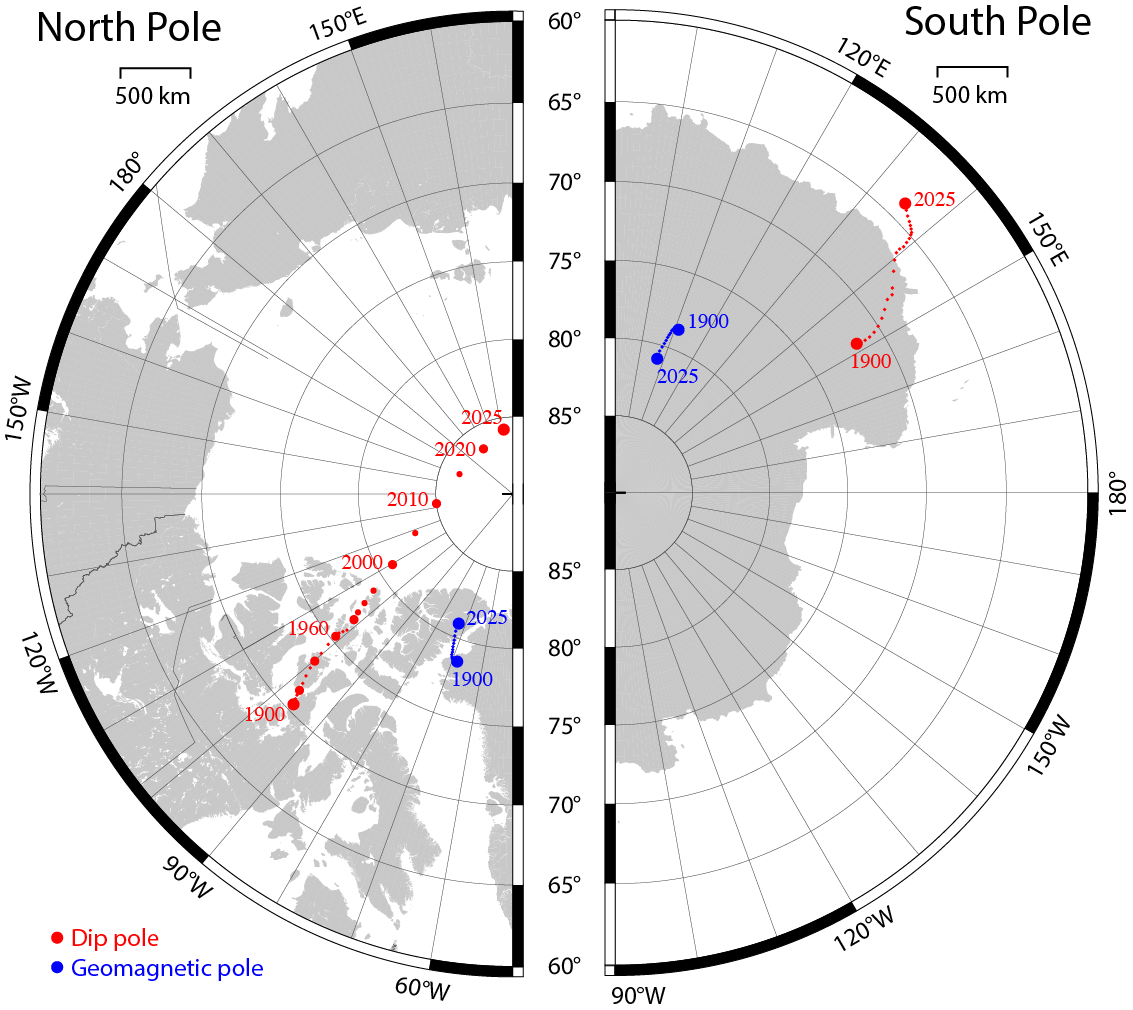
Positions of the north (left) and south (right) dip poles (red) and the geomagnetic poles (blue) from 1900.0 to 2025.0, estimated from the 13th Generation IGRF
In practice, there are many difficulties in the experimental determination of the locations of the dip poles, not least the remoteness and harsh climatic conditions. The main difficulty arises from the rapidly varying magnetic fields which originate in a region of near-Earth space called the magnetosphere. This region is defined by the pressure of the continuous stream of charged particles from the Sun, the so-called solar wind, on the Earth's magnetic field. Many dynamic electrical current systems exist on the surface of, and inside the magnetosphere and are connected to the ionised upper atmosphere at high latitudes. As a result, the dip poles move considerable distances over one day, tracing out approximately oval-shaped loci on a daily basis, with large variation from one day to the next depending on solar activity.
Another complicating factor is the presence of magnetic material in the underlying rocks, i.e. the crustal magnetic field. This is not included in models such as the IGRF but may be another reason for differences between the model dip poles and measured dip poles.
Scientists, map makers and polar explorers have an interest in the locations of the dip and geomagnetic poles. Although one cannot make any observations in the region of the geomagnetic poles that might indicate their positions, these poles are arguably of greater significance than the dip poles. This is because the auroral ovals, which are approximately 5° latitude bands where the spectacular aurora are likely to be seen, are centred on the geomagnetic poles. They are usually displaced slightly to the night-side of the geomagnetic poles and are very variable in size: bands of greatest activity occur between 15 and 25° from the geomagnetic poles. In relation to this, many coordinate systems used in studies of the Earth's magnetosphere have the dipole axis as one of their defining axes. In addition, magnetic field reversals are defined by the flipping of the geomagnetic poles. These ancient poles are defined by the direction of the ancient magnetic field frozen into certain kinds of rock, and in their derivation, make the assumption that the field is simply that of a tilted dipole located at the Earth's centre.
| North dip pole | South dip pole | North geomagnetic pole | South geomagnetic pole | |||||
|---|---|---|---|---|---|---|---|---|
| Epoch | Latitude | Longitude | Latitude | Longitude | Latitude | Longitude | Latitude | Longitude |
| 1900.0 | 70.46 | -96.19 | -71.72 | 148.32 | 78.68 | -68.79 | -78.68 | 111.21 |
| 1905.0 | 70.66 | -96.48 | -71.46 | 148.55 | 78.68 | -68.75 | -78.68 | 111.25 |
| 1910.0 | 70.79 | -96.72 | -71.15 | 148.64 | 78.66 | -68.72 | -78.66 | 111.28 |
| 1915.0 | 71.03 | -97.03 | -70.80 | 148.54 | 78.64 | -68.57 | -78.64 | 111.43 |
| 1920.0 | 71.34 | -97.39 | -70.41 | 148.20 | 78.63 | -68.38 | -78.63 | 111.62 |
| 1925.0 | 71.79 | -98.00 | -69.99 | 147.63 | 78.62 | -68.27 | -78.62 | 111.73 |
| 1930.0 | 72.27 | -98.69 | -69.52 | 146.79 | 78.60 | -68.26 | -78.60 | 111.74 |
| 1935.0 | 72.80 | -99.34 | -69.06 | 145.77 | 78.57 | -68.36 | -78.57 | 111.64 |
| 1940.0 | 73.30 | -99.87 | -68.57 | 144.60 | 78.55 | -68.51 | -78.55 | 111.49 |
| 1945.0 | 73.93 | -100.24 | -68.15 | 144.44 | 78.55 | -68.53 | -78.55 | 111.47 |
| 1950.0 | 74.64 | -100.86 | -67.89 | 143.55 | 78.55 | -68.85 | -78.55 | 111.15 |
| 1955.0 | 75.18 | -101.41 | -67.19 | 141.50 | 78.54 | -69.16 | -78.54 | 110.84 |
| 1960.0 | 75.30 | -101.03 | -66.70 | 140.23 | 78.58 | -69.47 | -78.58 | 110.53 |
| 1965.0 | 75.63 | -101.34 | -66.33 | 139.53 | 78.60 | -69.85 | -78.60 | 110.15 |
| 1970.0 | 75.88 | -100.98 | -66.02 | 139.40 | 78.66 | -70.18 | -78.66 | 109.82 |
| 1975.0 | 76.15 | -100.64 | -65.74 | 139.52 | 78.76 | -70.47 | -78.76 | 109.53 |
| 1980.0 | 76.91 | -101.68 | -65.42 | 139.34 | 78.88 | -70.76 | -78.88 | 109.24 |
| 1985.0 | 77.40 | -102.61 | -65.13 | 139.18 | 79.04 | -70.90 | -79.04 | 109.10 |
| 1990.0 | 78.09 | -103.68 | -64.91 | 138.90 | 79.21 | -71.13 | -79.21 | 108.87 |
| 1995.0 | 79.09 | -105.42 | -64.79 | 138.76 | 79.39 | -71.42 | -79.39 | 108.58 |
| 2000.0 | 80.97 | -109.64 | -64.66 | 138.30 | 79.61 | -71.57 | -79.61 | 108.43 |
| 2005.0 | 83.19 | -118.24 | -64.65 | 137.85 | 79.82 | -71.81 | -79.82 | 108.19 |
| 2010.0 | 85.02 | -132.84 | -64.43 | 137.32 | 80.09 | -72.21 | -80.09 | 107.79 |
| 2015.0 | 86.31 | -160.47 | -64.28 | 136.60 | 80.37 | -72.61 | -80.37 | 107.39 |
| 2020.0 | 86.49 | 162.76 | -64.08 | 135.86 | 80.65 | -72.68 | -80.65 | 107.32 |
| 2025.0 | 85.78 | 138.09 | -63.85 | 135.06 | 80.90 | -72.64 | -80.90 | 107.36 |